No orders have been issued today.
Author Archive
SOMEBODY’S PAYDAY
In Uncategorized on 05/28/2021 at 15:01No payday for Danny R. Love, Docket No. 8808-20, filed 5/28/21, one of Judge Morrison’s off-the-benchers. And maybe no payday for Citifinancial, who lent Danny $10K, of which Danny got $1894 in cash, while the rest was used to pay off the balance of Danny’s previous loan. Citifinancial did forgive $9K after nine (count ’em, nine) years of getting some payments and garnishing Danny’s wages. Of course, the stated rate of interest was 25.55%.
I said it long ago. “In the old days, it was six for five in seven days, or three broken fingers in eight; the sharks would lend a worker five dollars and get back six dollars in seven days. Should the worker not pay, the appropriate digits would.” See my blogpost “Family Feud,” 12/12/11. Now, of course, we have courts, benevolent institutional lenders, and the same poor workers, so no one gets hurt.
But it is a payday for IRS (maybe, if Danny has any money left), for tax on the cancellation of debt income Danny got when Citifinancial gave him the 1099-C for the $9K.
Danny tries to convince Judge Morrison that he wasn’t relieved of debt, because he settled out with another beneficent organization after suing them for “breach of contract, violation of the FTC, Fair Debt Collection Practices Act, violation of Tennessee debt collection law, and unfair predatory collection practices.” Transcript, at p. 6. Danny claims the Citifinancial loan was the same as the loan he stiped out.
Note Judge Morrison states “Love’s suit was dismissed with prejudice.” Transcript at p. 8. When a case settles, the parties stip to a discontinuance or dismissal of the predicate action with prejudice.
Except it’s not the same loan. There was no transfer of paper or collateral. The loan balances were different at the same time. Both the benevolent lenders were garnishing Danny’s wages at the same time. None of the payments one lender got showed up on the other’s books. And ultimately nothing shows the Citifinancial loan was satisfied when Danny stiped out the other loan.
I refrain from commenting on loans to people like Danny at interest rates of 25.55%. At least, not here.
“HOW GREEN WAS MY VALLEY” – PART DEUX
In Uncategorized on 05/27/2021 at 16:11Judge Christian A. (“Speedy”) Weiler defoliates another bunch of syndicated conservation easements with the “Joy Forever” Gambit. Here’s Green Valley Investors, LLC, Bobby A. Branch, Tax Matters Partner, et. al., Docket No. 17379-19, filed 5/27/21*, and three (count ’em, three) other syndicates.
It’s the same old “improvements out” at extinguishment story. For those coming late to this non-party, check out Section 1.170A-14(g)(6)(ii), Income Tax Regs. (the “Proceeds Regulation”).
And Judge Speedy lives up to his cognomen, as he takes us through the caselaw at warp speed.
“The Proceeds Regulation does not provide that ‘any amount, including that attributable to improvements, may be subtracted out’ of the proceeds. PBBM-Rose Hill, Ltd. v. Commissioner, 900 F.3d 193, 208 (5th Cir. 2018); see also Coal Prop. Holdings, LLC v. Commissioner, 153 T.C. 126, 138-40 (2019). Thus, language that subtracts the amount attributable to improvements from a condemnation award before calculating the percentage of the proceeds that would go to the donee violates the Proceeds Regulation. See, e.g., PBBM-Rose Hill, Ltd. v. Commissioner, 900 F.3d at 207-0 8; Coal Prop. Holdings, LLC v. Commissioner, 153 T.C. at 138-40; Sells v. Commissioner, T.C. Memo. 2021-12, at *14; Red Oak Estates, LLC v. Commissioner, T.C. Memo. 2020-116, at *15; Cottonwood Place, LLC v. Commissioner, T.C. Memo. 2020-115, at *15; Smith Lake, LLC v. Commissioner, T.C. Memo. 2020-107, at *8-*9; Engelwood Place, LLC v. Commissioner, T.C. Memo. 2020-105, at *9; Hewitt v. Commissioner, T.C. Memo. 2020-89, at *5; Oakbrook Land Holdings, LLC v. Commissioner, T.C. Memo. 2020-54, at *37-*38.” Order, at p. 7.
I’ve blogged all, or almost all, of these.
But because the Greenvalleys have appraisals, IRS loses its attempt at summary J on the overvaluation chops. There are questions of fact what the true values of the easements might have been at date of donation. So on to the trial, maybe.
Need I add that Judge Holmes’ comment about the need for trials following “very contestable readings of what it means for an easement to be perpetual” remains the ghost at the banquet. See my blogpost “They Always Must Be With Us,” 5/12/20.
DROPPING THE COGS
In Uncategorized on 05/26/2021 at 16:23John Legoski, 2021 T. C. Sum. Op. 15, filed 5/26/21, thought the $29K he got from Amazon was below the threshold for reporting payment card and third-party network payments. The 1099-k he got from Amazon Payments should have awakened him, but it didn’t, at least to the extent of reporting the $29K on his 1040-A.
John didn’t. No problem, AUR picked it up, and, untouched by human hands, gave John a SNOD for the tax on the $29K unreported income, plus a Section 6662 five-and-ten chop at no extra charge.
John ran a part-time dropship routine. One of my colleagues long ago had a similar game, with bicycles. Judge Pugh explains for the year at issue.
“…petitioner bought and sold items online, using a drop-shipping model in which he would purchase an item from a third party such as Walmart or Home Depot or through the online sales and auction website http://www.eBay.com, sell the item online on Amazon, and then arrange for the item to be shipped directly to the buyer. He would pay for the items through the online payment service PayPal. When a customer purchased an item from petitioner, Amazon Payments, Inc. (Amazon Payments), would receive the payment, deduct its fee, and then remit the remainder to him.” 2021 T. C. Memo. 15, at p. 3.
This phenomenon may explain the sudden proliferation of online apps, which claim to find the lowest price for items offered on these various sites, cutting out the dropshipper-arbitrageur.
Howbeit, whether or not Amazon Payments had to report John’s payout, they did. John was put wise on the trial, and caved.
John wanted to claim COGS. After all, Amazon paid him gross; he didn’t get the goods he dropshipped for nothing.
Except.
John hasn’t a scrap of paper to show what he bought and what he sold. The Michael Corleone Gambit won’t get you a Cohan.
John claims he lost money in the year at issue on the dropshipping. But no proof, no loss.
FOLSOM PRISON BLUES
In Uncategorized on 05/26/2021 at 09:53Today Judge Gale is again doing it all himself in Kiran Rawat, Petitioner and Raghvendra Singh, Intervenor, Docket No. 11350-18, filed 5/26/21. I missed Judge Gale’s 5/19/21 order, to which he adverts in today’s opus.
Ragh, a guest of CA, laments he can’t prepare for trial, which is on for June 7. “… the Court received a letter from intervenor Raghvendra Singh, wherein he requests that this case be continued to December 2021. In support of his request, Mr. Singh alleges: ‘Being a prisoner, I am not allowed to participate in any court action.’ He further alleges: ‘I expect my release in October, 2021. I need some time to prepare the case.’” Order, 5/19/21, at p. 1.
Judge Gale, having already communicated with the authorities at Kern State, wherein Ragh then resided, is assured that Ragh would appear for any Zoomie proceedings.
But Ragh was on the move. And today he echoes that classic lament from the late great John R. Cash. That song brings back memories. It was a favorite among us so long ago. My pocket transistor radio, and those of my fellows, echoed with the lonesome whistle; we’d call up Radio Dong Ba Thin (“Serving Cam Ranh, Phan Rang and Nha Trang”) and ask the GI DJ to dedicate that song to one of us with a derogatory but acceptable cognomen (e.g., “Louie the Lifer”) on the D Bar T Jamboree at 1600 local time. Those were the days. And if this is meaningless to you, consider yourself lucky. But I digress.
Judge Gale is also on the move.
“Officials at North Kern State Prison (NKSP) recently contacted the Court to advise that on May 20, 2021, Mr. Singh was transferred from NKSP to Folsom State Prison. Accordingly, the Court has been in contact with the proper officials at Folsom State Prison and is presently engaged in making the necessary arrangements to ensure that Mr. Singh will be made available on June 8, 2021, for the remote trial in this case.” Order, 5/26/21, at p. 1.
Hit it, Johnny. One last time, for old times’ sake.
“AND NOW FOR SOMETHING COMPLETELY DIFFERENT” – REDUX
In Uncategorized on 05/25/2021 at 23:41Lunch and a couple Sam Adamses at the Union Oyster House with my colleague and friend Peter Reilly, CPA, from Forbes.com’s first team. 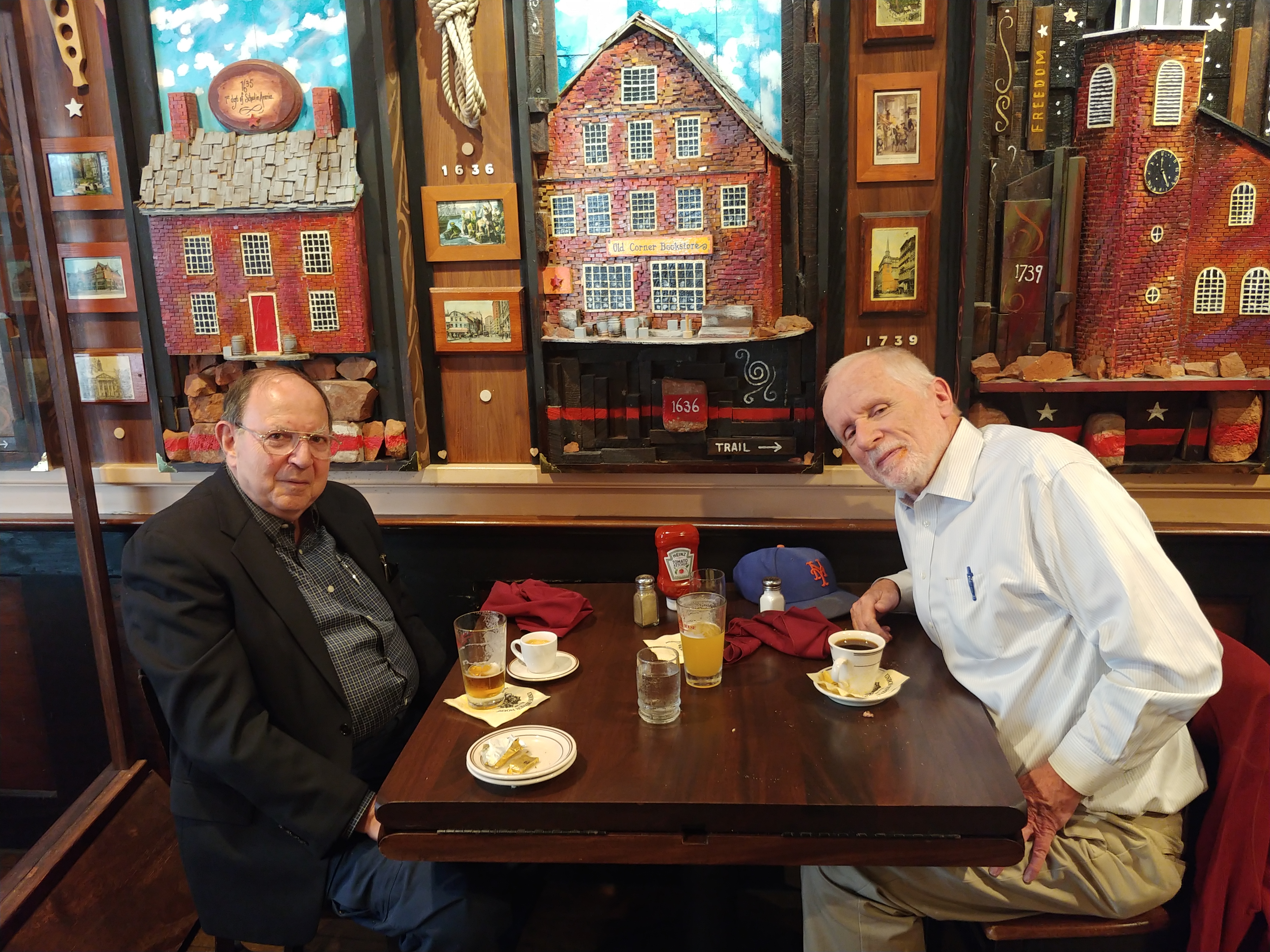
WITHDRAWAL MADE EASY
In Uncategorized on 05/25/2021 at 23:26Today Judge Buch rolls out the first iteration of the amended Rule 24(c) in Chester E. Lemon & Gigi Lemon, 12437-20, filed 5/25/21. It’s nothing to do with Chet & Gigi; it concerns their trusty ex-attorney, whom I’ll call DAK.
DAK wants out, and Chet & Gigi have another lawyer on deck and ready to go. DAK gets to withdraw, and Judge Buch will spell out the steps.
“Counsel desiring to withdraw as counsel for a party may file a notice of withdrawal as counsel if: (A) more than one counsel entered appearances for that party and at least one counsel will continue to serve as counsel for that party; (B) the notice of withdrawal is filed no later than 30 days before the first day of the Court’s session at which the case is calendared for trial; and (C) there is no objection to the withdrawal.” Order, at p.1.
Everyone agrees to let DAK out.
Trial is set for October. Note that the notice of withdrawal has to be filed 30 days before the first day of the session whereat trial will take place, even if trial is noticed for a date certain later than the first date of the session, and no one shows for calendar call.
Now maybe we can work on a notice of appearance for law firms, and leave separate checks for lunch.
Speaking of lunch, see my next following blogpost.
HOW MUCH EVIDENCE
In Uncategorized on 05/25/2021 at 23:13Every practitioner has asked that question when trying to assemble the facts for the case at hand, both what s/he must prove, and what the adversary must prove. Today there’s some useful learning from Judge Nega, when IRS is trying to prove that they sent a SNOD they can’t find to the last known address of Stanislava Chrobak, Docket No. 20155-18L, filed 5/25/21.
Ms C claims she never got the SNOD, and is petitioning a NITL directly, with no trip to Appeals; and she’s late.
Howbeit, here’s Judge Nega.
“Respondent attached to respondent’s motion a copy of a Certified Mailing List (CML) as evidence that, on May 10, 2016, respondent mailed by certified mail, bearing reference No. 7014 2120 0003 5386 4501, a notice of deficiency for tax years 2007, 2011, 2012, and 2013, to petitioner’s last known address (i.e., the Palos Hills address). Respondent also attached a copy of the CML showing that, on May 10, 2016, respondent mailed by certified mail, bearing reference No. 70142120 0003 5386 4495, a notice of deficiency for tax year 2009 to petitioner’s last known address (i.e., the Palos Hills address).” Order, at p. 3.
As to “last known address,” here’s Judge Nega’s take. Note Ms. C put in no papers responding to IRS’ motion to toss for want of jurisdiction.
“With respect to tax years 2007, 2009, 2011, 2012, and 2013, respondent contends that the notices of deficiency, each dated May 10, 2016, were mailed to petitioner’s last known address (i.e., the Palos Hills address). Respondent explains that petitioner untimely filed her tax returns for tax years 2008 and 2009, which she signed on June 8, 2015, and were received by the IRS on June 15, 2015. Respondent continues that on petitioner’s tax returns for 2008 and 2009, petitioner listed the Palos Hills address as her current home address. Furthermore, respondent elaborates that there is no record indicating that petitioner filed a tax return for tax year 2015. Thus, respondent states, had petitioner filed a tax return for tax year 2015 listing an address different than the Palos Hills address, the notices of deficiency, each dated May 10, 2016, would have been mailed to that address.” Order, at p. 3.
If confronted with similar circumstances, here’s at least some of what IRS has to produce, and what you have to counter.
COPY – PART DEUX
In Uncategorized on 05/24/2021 at 13:44I was wrong back on January 10 a year ago, when I predicted that Giorgio P. Martinelli, Docket No. 4122-18, would vanish without the human-interest story I wanted to bring y’all. See my blogpost “Copy,” 1/10/20.
Well, right now, in the Honolulu Zoomie courtroom, Giorgio is on the stand testifying to his brother’s poor health and how the offshore account really belongs to his brother. IRS’ counsel is putting up a good show, and FRE 803(4) just slowed down The Great Chieftain of the Jersey Boys, but Giorgio is a good witness.
I wish Frantic Frankie had tipped me off, but I guess he had other things on his mind.
Anyway, having to dig for copy keeps the blogger on his toes.
NOT CONDITIONAL, NOT TEMPORARY
In Uncategorized on 05/24/2021 at 08:19Four more get the ‘ollow square treatment today at The Glasshouse Vic Built. The only interesting note is found in Randy Godin, the second of the orders.
Ch J Maurice B (“Mighty Mo”) Foley explains a difference between Tax Court practice and one State’s (CA’s) approach.
Mr. G got a conditional suspension from the CA authorities. He asks Tax Court for reciprocal treatment.
Ch J Mighty Mo says “no.”
“This Court, however, does not impose conditional or temporary suspension as a form of discipline. We will suspend Mr. Godin as reciprocal discipline based upon his suspension in California. Mr. Godin may file a petition for reinstatement to practice before this Court upon his reinstatement to the practice of law in California.” Order, at p. 1.


You must be logged in to post a comment.